Showing posts with label changes. Show all posts

Wednesday, April 04, 2007

Spring planting and party plans


For the last 10 years we've had a big party in late April, timed mostly to coincide with various April events that deserve celebration, but not coincidentally also coinciding with the garden's best moment. Or is it the other way around? Have I gradually created a garden that looks its best at a time when we want to have a party (we've found that mid to late April gives us the best chance of relatively cool weather and no mosquitoes, at least at our house).

We skipped the party last year, which would have been the 11th annual, because of the construction. We actually toyed with the notion of having it in the midst of the building project and, if we had been at the just-framed stage, it might have worked but by mid-April we were into drywall and that was a mess that wouldn't haved mixed well with a party, even if the garden was looking better than I would have expected with no attention and construction going on all around it.

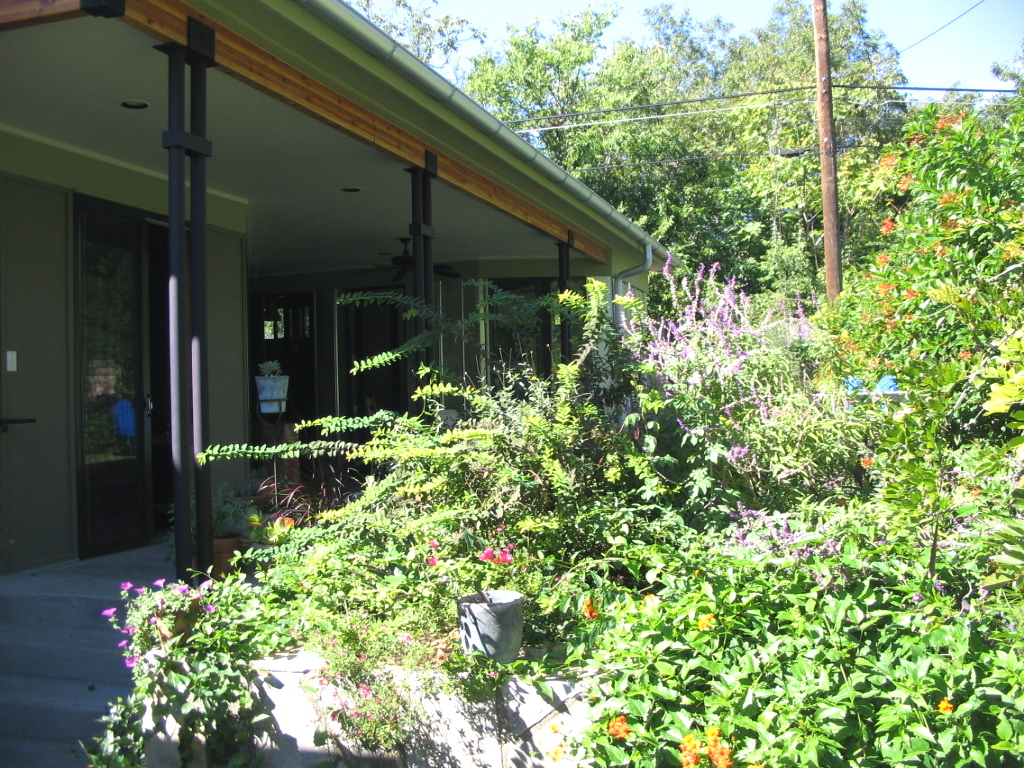
The first year we had the party — 1996 — the long back bed had been planted for one year. (I wish I had some digital pictures of the garden from those days; surely I have prints that I could scan. I'll have to look). In the intervening years that long L-shaped bed has changed and evolved. The only plants left from my original plan are a couple of red yucca (Hesperaloe parviflora). The picture at the top of the page is the long leg of the bed today, looking from front to back, past the wildly blooming Old Blush rose and the orchid tree, covered in its white flowers.

That original configuration also included the only plant that existed in the back yard (other than weeds and Turk's cap) before we built the bed: a large multi-stemmed yucca, possibly twisted leaf yucca. Over several years that yucca deteriorated, plagued by various insect infestations. About five years ago we cut it down and thought we dug it up but it returned and we let it grow back, filling in the back of that part of the bed. This spring we decided that it just looked straggly and unattractive and were determined to be done with it once and for all. My able assistant worked long and tirelessly until, finally, he extracted an enormous, bulbous root, about three feet long and probably 18 inches around. After that I got the bright idea that I wanted to dig up the hamelia patens that had been in the ground beside the yucca for the past seven or eight years. It was the orange variety and I much prefer the red one I have in the far back. Besides, witih it gone (it was HUGE in the summer, six to eight feet wide and tall) I would have the perfect place for the agave parryii that I bought with my birthday gift certificate. So Dan set to with my new garden fork and extracted the hamelia.

I built a circle of stones to elevate the agave a bit and improve its drainage and transplanted a Pride of Barbados (Caesalpinia pulcherrima) seedling from the front yard behind it. I put (probably too many) annuals and a couple of small perennials around it: some rather sad California poppies in 4-inch pots that I've had since December but never planted, three bat-face cupheas, three winecups (the creeping kind not the standing which I prefer but couldn't find in 4-inch), three 4-inch cleomes, and two one-gallon salvia superba "May Night" (I have some other salivas called "May Night" but they were labeled salvia nemarosa; they look identical to me). Also the one-gallon dark blue plumbago I bought last fall and couldn't find a home for. Oh, and I plan to plant the Cecile Brunner rose that my mom sent me in a big pot in the spot where the hamelia was.


I also finally got the yellow columbine that was dug up when the French drain was built last spring back in the ground (just in time for it to bloom) and put the salvia guaranitica "Black and Blue" that's been overcrowded in its pot for several years in the ground too (that's the pot I'll use for Cecile Brunner). Now I just have a few more plants to get in the ground (some inland sea oats and a couple of salvia roemarianas/cedar sage).

It's a good thing I'm finally getting everything in the ground because we finally decided yesterday, a bit late, to go ahead with this year's party and now I have a little less than three weeks to get the garden in shape (with the added incentive of a visit by the Austin garden bloggers on the day following the party.

The back garden is actually looking quite lovely right now. Hopefully it will hold up for a few more weeks.

Tuesday, February 20, 2007

Spring cleaning (or kvetching)

I'm in my usual pre-spring garden funk or at least state of garden indecision. I realized a few years ago that, about this time, before plants resprout, when bare stems are the only thing showing above ground, I start to wonder if the garden is worth the trouble. I look around and all I can see are the problems and none — or at least not many — of the rewards.

Last weekend I finally got out and started cutting back the plants that froze to the ground during the several unusually cold spells we've had this winter (the lowest we've seen here was about 22, I think): the salvia "Anthony Parker" in the downstairs bed, the big salvia guaranitica "Black and Blue" in a pot, several clumps of salvia leucantha, the zexmenia at the top of the stairs. Also the two big clumps of Mexican flame vine that hang down over the wall. Those vines have survived for years, in fact one of the two clumps sprang up where a long tendril of the original plant reached across the bed and rooted. I've been amazed by their hardiness over the years (I planted the original assuming it would die the first winter). This year may be the end though. I see no evidence of green, even right down at the ground. I'll wait a bit longer before I pull them up but I'm not optimistic. Still to be cut back are the tecoma stans, the hamelia and the Pride of Barbados in the far back. Also throughout the long upstairs bed are masses of purple heart in their slumped and slimy post-freeze state. And various salvia greggiis needing severe haircuts before they start setting blooms.

With some of the dead wood out of the way I can see things I'd like to change: remove the big yucca at the corner of the L-shaped bed and the orange hamelia beside it. Replace both with a new red hamelia set further back into the corner. I think the hamelia could hold its own with the wisteria that tries to creep in every year. Then, once the original hamelia is gone, I could move the salvia leucantha over to give the Maggie rose more space.

We had some of the scrubby trees along the north edge (and on the other side of the fence) of the upstairs yard removed when the tree people were here dealing with the branches downed by the ice storm. They took out a hackberry that was growing up into the wisteria and an insidious mulberry that will resprout in a minute — okay a few months — if I give it any slack. I'm thinking Round-up on the stump. Or boiling oil. Also removed was some kind of overgrown nandina-ish thing that was only served as mooring for errant lashings of wisteria creeping along the ground, looking for a way upward. The tree guys also cleared the wisteria off the power pole and, most satisfyingly, removed the four Trees of Heaven growing up between our house and the duplex next door. The trees were on the duplex's property and the owner had refused for years to remove them, even though they were clearly a menace to her property. We finally said we'll pay for it ourselves and then she said, oh, I'll be glad to pay half.

So the upstairs yard is looking a bit clearer but the downstairs yard is disaster. All of the grass, except for various odd straggles of Bermuda, is dead, the arbor is rotten and collapsing and the whole area has become a repository of cracked pots, old ice chests, and various other detritus. Depressing doesn't begin to describe it. In my brighter moments I envision a sort of terrace of large stones set in gravel, surrounded by plants rather than bare dirt, shaded by a new wisteria-covered arbor, with perhaps a fountain at the center. Then I look at what's actually there and start hacking at the mutant eupatorium of unknown variety that has sprawled randomly and unattractively out of its assigned spot. Or stoop to ponder the once lovely agave montana, now apparently dying a slow and undignified death. Can it be saved? should it be moved? taken out of its pot? put where?

Then there are the roses. To prune or not? And when? And how much? But that's another post.

Tuesday, October 31, 2006

Finally, some progress (I hope)

Last Sunday I finally decided to take some action in the garden. I puttered around for a bit, trimming here, pulling a weed here, before I got up the nerve to chop down the overstayed-its-welcome hypericum/St. John's Wort that was blocking my view (and air and sun) of the "Maggie" rose that I planted a year and a half ago or so.

I planted the hypericum in March 2003 at the base of an orange Tecoma stans (we always called it the orange bells). I was looking for something that would look good in the spring when the orange bells was just sticks waiting to sprout (the lightest freeze killed it down to the ground). Whatever I planted needed to be able to survive being smothered by the orange bells when it reached its full height and spread (about 10 feet by 8 feet) later in the summer. Someone at Barton Springs Nursery suggested the hypericum, supposedly a dwarf variety, or daylilies. I've never been a daylily kind of person so I went for the shrub.

For the first few years it didn't do much but by 2005 it had grown larger than I expected, maybe four feet tall and wide and had bloomed a bit. I loved the buds, tiny balls that opened into clear yellow flowers. Unfortunately there weren't many flowers and the plant suffered in July and August. It didn't die but it didn't look great either. That wasn't so bad when it was covered with the sprawling orange bells but . . .

In April 2005 I decided the orange bells had to go. Unlike its yellow sibling (or parent?) it didn't bloom profusely, most years not flowering until late July or August, sometimes even later. And, although the individual flowers were beautiful there just weren't enough of them. And the plant itself was so ungainly and huge. It blocked my view of the upstairs garden from the kitchen window and smothered everything around it.

After a trip to the Rose Emporium with a friend where we sniffed every rose that was blooming, I had my eye on a rose called "Maggie" that was beautiful and smelled wonderful. I came home and told my husband I'd decided to take the orange bells out and put in the rose and some other stuff.

Hah! We (mostly he) spent a week of evenings digging and hacking roots (some 4 or 5 inches across) and shoving the root ball back and forth trying to loosen it up. We talked about hiring someone with a stronger back and better tools but in the end we got it out of there. I dug in a bunch of compost and then went crazy planting what looked like an enormous space.

I checked my garden notebook on Sunday and saw that I planted the rose, a Mexican bush sage (one with solid purple blooms) that I'd had in a pot for a year or so while I tried to find a spot for it, a magenta salvia greggii, some purple and fuschia verbenas and some 4-inch cleome transplants. All in an area about 10 feet by 4 feet that was already home to the hypericum and a small agave as well as a zexmenia. And bordered by a hamelia patens (fire bush) that in April was also nothing but sticks and two clumps of freeze-pruned Mexican flame vine that always go out of control by mid-summer.

Even at the time I wondered if I was putting too much into the space and noted that I always underestimate the summer size of the hamelia. But, I wrote, the cleomes were annuals and the verbena would be easy to move. It's bound to be better than the orange bells, I wrote.

And that first year it was. The hamelia indeed got bigger than I remembered and it and the Mexican bush sage mingled together but that worked okay. The salvia bloomed and even the hypericum had a few more flowers than I remembered from the year before. The few blooms I got out of Maggie that first year were as beautiful as I hoped. The cleomes and verbena filled in the blank spaces while the other plants were growing. It was all a bit out of control but I generally like that kind of look.

But the changes we made to the house and the surrounding hardscape this spring changed my perspective, literally. That area of the garden is now viewed not only from my kitchen but also from the new sitting room. And the hypericum was at the most prominent point, right at the top of the reconfigured stairs coming up from the screened porch and the downstairs yard.

By August the bush sage had overwhelmed the rose, abetted by the rampant, twining growth of the flame vine. The hypericum and zexmenia (and the vine) had spurred each other on to ever greater heights, all intertwined and, in the case of the hypericum, browned by the summer heat. I kept pruning things back to try to give the rose some room but, in the end, something had to go.


Here's a (bad) picture of what it looked like before. You can see what a mess the whole area was and how it relates to the new porch.

So on Sunday I chopped the hypericum down. I still need to dig up the stump (I suspect it's one of those plants that will shoot back up, even from leafless, bare sticks) and, even though it looks a bit barren right now, I think in the long run it will be an improvement. I just have to resist the urge to fill up the space with whatever plants I have languishing in pots or some bargain I can't resist at the garden store.

My question now is whether to try to dig up the rose and move it over a foot or so, giving it some more breathing room from the bush sage. I've never tried to transplant a rose. I'm thinking maybe Maggie will sort of grow sideways to fill up the new vacant space, kind of like the bush sage does to stay out of the way of the hamelia.

I'm also thinking about digging up the agave (it suffered from years of being covered all summer by the orange bells; twice the crown of new stalks either rotted off or were eaten by something). I'll replace the agave with another slightly larger, more attractive agave I have in a pot. The magenta salvia has grown out over the edge of wall, pushed out of shape by the hypericum, but stilll blooming. I'll leave it and the flame vine even though the vine sends out tendrils that ensnare everything. But those orange flowers are hard to beat, especially spilling down over the wall.