Showing posts with label heat. Show all posts

Friday, June 15, 2007

June bloggers' bloom day


Bat-face cuphea and winecups

Once again it's Garden Bloggers' Bloom Day, sponsored by Carole at May Dreams Gardens, who invites gardeners everywhere to let us in on what's blooming in their gardens on the 15th of each month.

My garden has entered its jungle-like state early this year, spurred on by an extraordinarily rainy and cool spring, causing plants to sprawl this way and that, growing over their neighbors and defying all of my best-laid plans. I often overplant and it looks like this year is no exception. The great growing conditions combined with my inability to judge how much space new plants will eventually require or to remember how big plants that have died to the ground will get later in the season has made for a garden that looks more like a thicket than an intentional space. And then the heat set in and my enthusiasm for going out and making changes or even pruning waned in direct correlation to the temperature. And the heat has definitely set in. All that's left of our lovely cool spring is a faint memory and lot of overgrown plants.

Enough of the whining. Here's some of what's going on in one Central Texas garden in mid-June.

At least one of the workhorses of my summer garden has started blooming. The first intricate blooms of the Pride of Barbados opened yesterday (interestingly, the first flowers are on the POB that we transplanted from the front yard this spring; the much more established plant in the far back is covered in buds but not yet flowering; the ones in more shade in the front are just setting buds).


A close-up of a Pride of Barbados flower


The whole bloom stalk; I love the way the buds come out in that pyramid of little balls

The POB's faithful summer companions, the hamelia patens and the tecoma stans are not flowering, although the tecoma stans did have a few blooms a week or so ago. Behind those plants in the far back, the trumpet vine "Madame Galen" started blooming this week and has quite a few more buds about to open. And draping over the wall, the Mexican flame vine is adding more orange to the summer mix.


Trumpet vine "Madame Galen"


Mexican flame vine; check out the claw-like new buds


Another summer bloomer, the bat-face cuphea (that's it up at the top) is blooming wildly, mixing well with its neighbor the winecups, which are continuing to be covered in blooms on long vines that are crawling gracefully over everything around them. Behind the cuphea the cleomes are continuing to bloom, white and pink and purple.


The salvia guarantica "Black and Blue" that I transplanted into the ground next to the new porch from the pot where it had lived for four years or so is thriving, huge and covered in brilliant spires of cobalt blue. Next to it the zexmenia is also blanketed with yellow flowers.


Salvia guarantica "Black and Blue" with zexmenia behind

Several other salvias — greggii, roemariana, and nemarosa — are still blooming sporadically. The greggii and roemariana should probably be cut way back and would probably rebloom while the nemarosa just needs to be deadheaded more regularly.

Another reliable summer bloomer is the pavonia, which has cropped up in several places (it seeds out wildly). Its pink flowers open in the morning and close by late afternoon and I couldn't get a good shot of it weaving its way through the agave lopantha before the flowers closed today. Maybe tomorrow.

All four roses have continued to bloom although the heat is taking its toll. Since last month Climbing Pinkie put on a substantial second flush of blooms, now mostly faded, while Old Blush is just now putting out a second flush. Its new flowers are much smaller than the first round. The new Cecille Brunner in a pot is continuing to bloom as is Maggie.

Other things blooming here and there are the orange bulbine, a pot of mixed verbena, and the purple heart all over the place (a major source of my thicket problems!). The new heartleaf skullcap from Pam at Digging bloomed but is struggling to hold its own between the sprawling salvia guarantica and the columbine, which is still holding on to a few flowers.

And one of two mystery seedlings (the other turned out to be a Gulf Coast penstemon, lost from its brothers and sisters in the front yard) has made itself known as a coneflower. I used to have coneflowers in the long bed and I thought they were all gone. But there's this one left. Maybe I'll have more next year.

Thursday, September 07, 2006

Survival of the fittest


In her post on Digging, Pam wondered how my garden survived not only the record heat of August but also the neglect imposed by our recent construction project (not to mention the insult of the construction itself). My first thought was good karma, some kindness from the gardening gods. But the real answer I think is more related to survival of the fittest (with a little luck thrown in for good measure; we had a wonderful architect and contractor — a design/build firm — and subs who were more careful with the garden than I ever could have imagined).

Some background (skip ahead to the end if you'd rather avoid the long-winded details):

The heart of the garden is a long L-shaped bed in the upstairs part of our back yard (our lot is on two levels with a four-foot-tall stone retaining wall separating the two levels. The original house is on the lower level and the new addition is on the upper level). When we moved in 12 years ago the only thing living in the upstairs yard was a large yucca and a straggly rose bush. We had several dead trees removed and I pondered the emptiness for six months. The next spring I hired someone to dig the L-shaped bed; the long leg — about 30 feet — is on the south side of a stockade fence, while the short leg — about 12 feet — runs along the top of the stone wall. Both parts face south and west, with almost no shade. The new beds were amended with quite a lot of compost and in at least some parts (behind the retaining wall) the soil is quite deep. Elsewhere it's maybe 8-12 inches over limestone.

I had done some gardening on a small scale at our previous house (someone gave me Wasowski and Ryan's Gardening with Native Texas Plants for a wedding present 20 years ago) and I knew I wanted native or at least drought-tolerant plants. So the original planting had clumps of red yucca (Hesperaloe parviflora), lantana "Irene," purple coneflower, coreopsis, salvia leucantha, fall obedient plant and calylophus. The ends were anchored by large clumps of salvia "Indigo Spires" and pink salvia greggii.

All that remains after 12 years is one clump of the red yucca (oh and that original yucca; we tried to dig it up once but it refused to give up the ghost and made a comeback from roots the next spring; it lives on). Some things reached the end of their natural life, some I sent to an early grave either through miscalculations regarding care or because I got tired of them for one reason or another.

I tremble to think of the plants that have poured through that bed (not to mention other smaller beds I've added since) in the last 12 years. In looking back through my sporadically kept garden notebook I can see one trend: If I had to water a plant to keep it alive it was history. I've moved more and more in that direction over the years. I'm willing to water plants in pots but (at least until recently) the upstairs garden only got water irregularly, maybe once or twice a month. (I usually add Back to Nature cotton burr compost from Barton Springs Nursery as mulch in the spring but I didn't get to do that this year.)

I've lost (or given up on) a lot of plants but those that remain are tough. I don't think there's a single plant in the upper back yard that really needs to be watered to live (to thrive and bloom is another story). The beds up there haven't changed since last year (my usual spring plant-buying frenzy was thwarted this year) and last summer — admittedly nothing to match this summer — everything survived.

This summer our experience of the upstairs garden changed dramatically. We moved into a new addition to our house in July that opens directly onto that garden. Both our new sitting room and bedroom, as well as our offices (my husband and I work from home), have views to the garden. So I have a newly vested interest in keeping that part looking good. Starting in mid-July I watered each section deeply once a week or so with my favorite small sprinkler (I've always meant to put soaker hoses in but every spring I wait too long and it gets so overgrown I can't push the hose through).

The yellow bells, Pride of Barbados, Turk's cap, hamelia, and zexmenia probably wouldn't be covered in blooms if I hadn't watered but I'm fairly sure they would have survived. I know the salvia greggii wouldn't be blooming again yet without the extra water but the salvia leucantha would have survived and bloomed anyway, I think, water or no water. The roses are the one thing I'm not sure of (I'm new to roses but I have three: Old Blush, Climbing Pinkie, and Maggie. One interesting thing is that all three did better than ever this spring and early summer with no supplemental watering, no fertilizer, nothing. Is there a lesson there?)

Other parts of the garden don't look so good right now (I haven't put up any pictures of those parts!). Some of the problems are a result of the construction and some a result of neglect. But not much, if anything, has died outright. I think the key was that everything that might have died has been gradually culled out (if I'd had a chance to add things this spring no doubt some of them would have died). As I said: survival of the fittest.

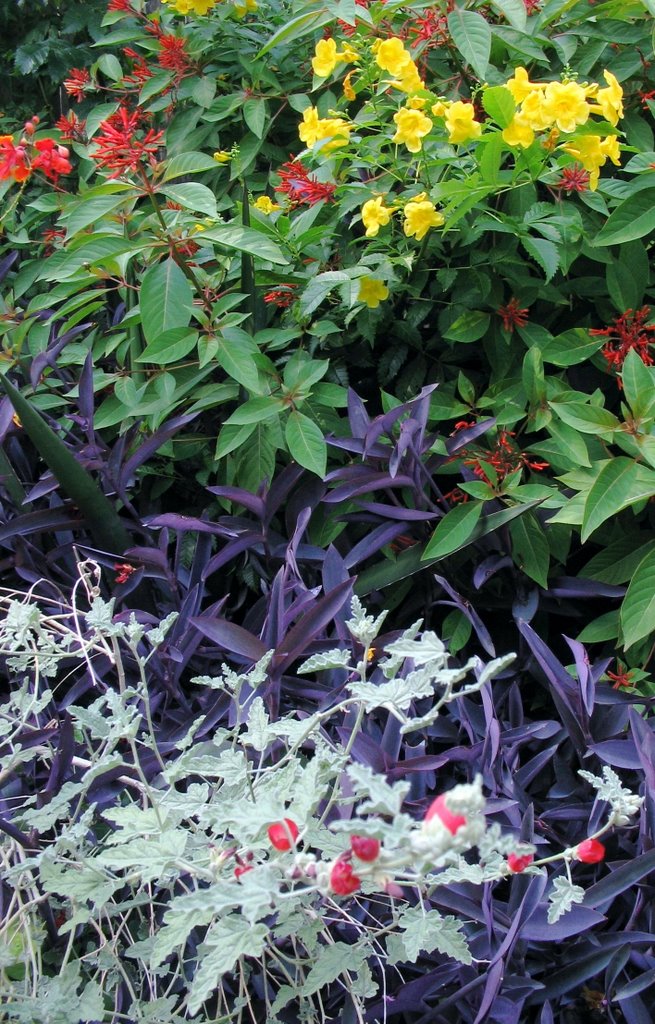
(The picture at the top is some of the toughest stuff in the garden, although it's in a newer bed, at the far back of the upstairs yard. From the top left: red hamelia/fire bush, tecoma stans/yellow bells, purple heart, and a silver-leafed, reddish salmon-flowered mallow I got at Big Red Sun a few years ago.)