Showing posts with label history. Show all posts

Wednesday, May 09, 2007

Plant or pet?


Closeup of the salmon-pink bloom of the red yucca


Pondering a few changes in the garden has reminded me of something D always says when I'm trying to decide whether I've reached the point of no return with one plant or another: "Well, it's not as if it's a pet." Sometimes I find it easy to agree with him and out that plant goes, sometimes dug up and moved elsewhere, sometimes passed on to a friend, sometimes into the yard waste bag (yes, I know. I should be composting).

But, as in so many other parts of my life, I rarely come to a quick decision. Usually I waver, considering all the possibilities. Sometimes I consider for so long that the plant finally dies and the decision is made for me.

Occasionally though the plant takes matters into its own hands (leaves?) and renders the decision even more difficult. A plea for survival? Who knows.

Last year I lost patience with the one remaining clump of red yucca (Hesperaloe parviflora) in the long upstairs bed. For the second year in a row it didn't send up even one bloom stalk. And it is an incubator for hackberries and Turk's cap. The seedlings spring up amidst the yucca fronds and are impossible to eradicate.

When I originally planted the L-shaped bed in 1995 I put in three clumps of the yucca (two one-gallon plants in each clump, I think). The idea was that the salmon-pink bloom stalks were attractive in their own right, and also that the rigid but arching stalks of the plant itself would add structure and give some winter interest to a garden made up mostly of plants that froze to the ground.

All well and good for a number of years. The clumps got larger and bloomed profusely. At some point, for reasons lost to memory, we dug up two of the three clumps. The remaining clump is in the long arm of the bed, between the Old Blush rose and the Climbing Pinkie on the steel tepee. The clump is about three feet deep and five feet wide, a substantial amount of real estate in my relatively small garden.

This spring I had every intention of pulling out the entire clump and replacing it with something new. I hadn't figured out exactly what that something new would be so I delayed removing the yucca. And then one day I noticed the reddish tips of several bloom stalks. And then more and more. All told the plant has sent up twelve stalks. The most ever, I think, and for no clear reason. I didn't fertilize it at all or water substantially more. We have gotten a fair amount of rain this spring and the pruning of the wisteria off the utility pole increased the amount of sun in that area of the garden.


So now I'm deeply conflicted. On the one hand, the yucca blooms are lovely, both up close with their yellow interiors and in a mass. And they are a hummingbird magnet. On the other hand the plant takes up a lot of space. And the salmony color of the blooms doesn't really mix well with others, particularly not the pink roses on either side. But the upright leaning stalks are an interesting companion to the wands of orange bulbine planted underneath (purely by chance; I'm sure I didn't give this a thought when I did the planting).

I think my real problem is an inability to get rid of anything that's blooming. I love flowers (although I have become more interested in foliage over the years) so a plant that's supposed to bloom but doesn't is an easy mark for me. But show me some flowers and I'm much less decisive.

What do you think? Should it stay or should it go? Or should I just procrastinate a bit longer?

Wednesday, April 04, 2007

Spring planting and party plans


For the last 10 years we've had a big party in late April, timed mostly to coincide with various April events that deserve celebration, but not coincidentally also coinciding with the garden's best moment. Or is it the other way around? Have I gradually created a garden that looks its best at a time when we want to have a party (we've found that mid to late April gives us the best chance of relatively cool weather and no mosquitoes, at least at our house).

We skipped the party last year, which would have been the 11th annual, because of the construction. We actually toyed with the notion of having it in the midst of the building project and, if we had been at the just-framed stage, it might have worked but by mid-April we were into drywall and that was a mess that wouldn't haved mixed well with a party, even if the garden was looking better than I would have expected with no attention and construction going on all around it.

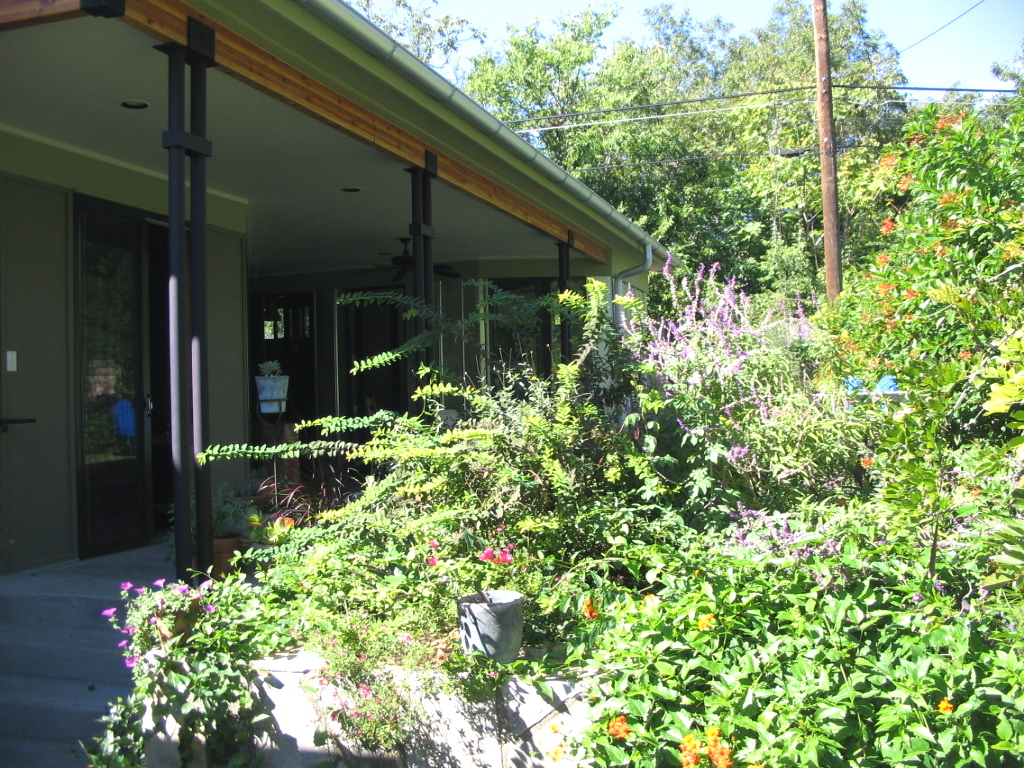
The first year we had the party — 1996 — the long back bed had been planted for one year. (I wish I had some digital pictures of the garden from those days; surely I have prints that I could scan. I'll have to look). In the intervening years that long L-shaped bed has changed and evolved. The only plants left from my original plan are a couple of red yucca (Hesperaloe parviflora). The picture at the top of the page is the long leg of the bed today, looking from front to back, past the wildly blooming Old Blush rose and the orchid tree, covered in its white flowers.

That original configuration also included the only plant that existed in the back yard (other than weeds and Turk's cap) before we built the bed: a large multi-stemmed yucca, possibly twisted leaf yucca. Over several years that yucca deteriorated, plagued by various insect infestations. About five years ago we cut it down and thought we dug it up but it returned and we let it grow back, filling in the back of that part of the bed. This spring we decided that it just looked straggly and unattractive and were determined to be done with it once and for all. My able assistant worked long and tirelessly until, finally, he extracted an enormous, bulbous root, about three feet long and probably 18 inches around. After that I got the bright idea that I wanted to dig up the hamelia patens that had been in the ground beside the yucca for the past seven or eight years. It was the orange variety and I much prefer the red one I have in the far back. Besides, witih it gone (it was HUGE in the summer, six to eight feet wide and tall) I would have the perfect place for the agave parryii that I bought with my birthday gift certificate. So Dan set to with my new garden fork and extracted the hamelia.

I built a circle of stones to elevate the agave a bit and improve its drainage and transplanted a Pride of Barbados (Caesalpinia pulcherrima) seedling from the front yard behind it. I put (probably too many) annuals and a couple of small perennials around it: some rather sad California poppies in 4-inch pots that I've had since December but never planted, three bat-face cupheas, three winecups (the creeping kind not the standing which I prefer but couldn't find in 4-inch), three 4-inch cleomes, and two one-gallon salvia superba "May Night" (I have some other salivas called "May Night" but they were labeled salvia nemarosa; they look identical to me). Also the one-gallon dark blue plumbago I bought last fall and couldn't find a home for. Oh, and I plan to plant the Cecile Brunner rose that my mom sent me in a big pot in the spot where the hamelia was.


I also finally got the yellow columbine that was dug up when the French drain was built last spring back in the ground (just in time for it to bloom) and put the salvia guaranitica "Black and Blue" that's been overcrowded in its pot for several years in the ground too (that's the pot I'll use for Cecile Brunner). Now I just have a few more plants to get in the ground (some inland sea oats and a couple of salvia roemarianas/cedar sage).

It's a good thing I'm finally getting everything in the ground because we finally decided yesterday, a bit late, to go ahead with this year's party and now I have a little less than three weeks to get the garden in shape (with the added incentive of a visit by the Austin garden bloggers on the day following the party.

The back garden is actually looking quite lovely right now. Hopefully it will hold up for a few more weeks.

Tuesday, October 31, 2006

Finally, some progress (I hope)

Last Sunday I finally decided to take some action in the garden. I puttered around for a bit, trimming here, pulling a weed here, before I got up the nerve to chop down the overstayed-its-welcome hypericum/St. John's Wort that was blocking my view (and air and sun) of the "Maggie" rose that I planted a year and a half ago or so.

I planted the hypericum in March 2003 at the base of an orange Tecoma stans (we always called it the orange bells). I was looking for something that would look good in the spring when the orange bells was just sticks waiting to sprout (the lightest freeze killed it down to the ground). Whatever I planted needed to be able to survive being smothered by the orange bells when it reached its full height and spread (about 10 feet by 8 feet) later in the summer. Someone at Barton Springs Nursery suggested the hypericum, supposedly a dwarf variety, or daylilies. I've never been a daylily kind of person so I went for the shrub.

For the first few years it didn't do much but by 2005 it had grown larger than I expected, maybe four feet tall and wide and had bloomed a bit. I loved the buds, tiny balls that opened into clear yellow flowers. Unfortunately there weren't many flowers and the plant suffered in July and August. It didn't die but it didn't look great either. That wasn't so bad when it was covered with the sprawling orange bells but . . .

In April 2005 I decided the orange bells had to go. Unlike its yellow sibling (or parent?) it didn't bloom profusely, most years not flowering until late July or August, sometimes even later. And, although the individual flowers were beautiful there just weren't enough of them. And the plant itself was so ungainly and huge. It blocked my view of the upstairs garden from the kitchen window and smothered everything around it.

After a trip to the Rose Emporium with a friend where we sniffed every rose that was blooming, I had my eye on a rose called "Maggie" that was beautiful and smelled wonderful. I came home and told my husband I'd decided to take the orange bells out and put in the rose and some other stuff.

Hah! We (mostly he) spent a week of evenings digging and hacking roots (some 4 or 5 inches across) and shoving the root ball back and forth trying to loosen it up. We talked about hiring someone with a stronger back and better tools but in the end we got it out of there. I dug in a bunch of compost and then went crazy planting what looked like an enormous space.

I checked my garden notebook on Sunday and saw that I planted the rose, a Mexican bush sage (one with solid purple blooms) that I'd had in a pot for a year or so while I tried to find a spot for it, a magenta salvia greggii, some purple and fuschia verbenas and some 4-inch cleome transplants. All in an area about 10 feet by 4 feet that was already home to the hypericum and a small agave as well as a zexmenia. And bordered by a hamelia patens (fire bush) that in April was also nothing but sticks and two clumps of freeze-pruned Mexican flame vine that always go out of control by mid-summer.

Even at the time I wondered if I was putting too much into the space and noted that I always underestimate the summer size of the hamelia. But, I wrote, the cleomes were annuals and the verbena would be easy to move. It's bound to be better than the orange bells, I wrote.

And that first year it was. The hamelia indeed got bigger than I remembered and it and the Mexican bush sage mingled together but that worked okay. The salvia bloomed and even the hypericum had a few more flowers than I remembered from the year before. The few blooms I got out of Maggie that first year were as beautiful as I hoped. The cleomes and verbena filled in the blank spaces while the other plants were growing. It was all a bit out of control but I generally like that kind of look.

But the changes we made to the house and the surrounding hardscape this spring changed my perspective, literally. That area of the garden is now viewed not only from my kitchen but also from the new sitting room. And the hypericum was at the most prominent point, right at the top of the reconfigured stairs coming up from the screened porch and the downstairs yard.

By August the bush sage had overwhelmed the rose, abetted by the rampant, twining growth of the flame vine. The hypericum and zexmenia (and the vine) had spurred each other on to ever greater heights, all intertwined and, in the case of the hypericum, browned by the summer heat. I kept pruning things back to try to give the rose some room but, in the end, something had to go.


Here's a (bad) picture of what it looked like before. You can see what a mess the whole area was and how it relates to the new porch.

So on Sunday I chopped the hypericum down. I still need to dig up the stump (I suspect it's one of those plants that will shoot back up, even from leafless, bare sticks) and, even though it looks a bit barren right now, I think in the long run it will be an improvement. I just have to resist the urge to fill up the space with whatever plants I have languishing in pots or some bargain I can't resist at the garden store.

My question now is whether to try to dig up the rose and move it over a foot or so, giving it some more breathing room from the bush sage. I've never tried to transplant a rose. I'm thinking maybe Maggie will sort of grow sideways to fill up the new vacant space, kind of like the bush sage does to stay out of the way of the hamelia.

I'm also thinking about digging up the agave (it suffered from years of being covered all summer by the orange bells; twice the crown of new stalks either rotted off or were eaten by something). I'll replace the agave with another slightly larger, more attractive agave I have in a pot. The magenta salvia has grown out over the edge of wall, pushed out of shape by the hypericum, but stilll blooming. I'll leave it and the flame vine even though the vine sends out tendrils that ensnare everything. But those orange flowers are hard to beat, especially spilling down over the wall.

Thursday, September 07, 2006

Survival of the fittest


In her post on Digging, Pam wondered how my garden survived not only the record heat of August but also the neglect imposed by our recent construction project (not to mention the insult of the construction itself). My first thought was good karma, some kindness from the gardening gods. But the real answer I think is more related to survival of the fittest (with a little luck thrown in for good measure; we had a wonderful architect and contractor — a design/build firm — and subs who were more careful with the garden than I ever could have imagined).

Some background (skip ahead to the end if you'd rather avoid the long-winded details):

The heart of the garden is a long L-shaped bed in the upstairs part of our back yard (our lot is on two levels with a four-foot-tall stone retaining wall separating the two levels. The original house is on the lower level and the new addition is on the upper level). When we moved in 12 years ago the only thing living in the upstairs yard was a large yucca and a straggly rose bush. We had several dead trees removed and I pondered the emptiness for six months. The next spring I hired someone to dig the L-shaped bed; the long leg — about 30 feet — is on the south side of a stockade fence, while the short leg — about 12 feet — runs along the top of the stone wall. Both parts face south and west, with almost no shade. The new beds were amended with quite a lot of compost and in at least some parts (behind the retaining wall) the soil is quite deep. Elsewhere it's maybe 8-12 inches over limestone.

I had done some gardening on a small scale at our previous house (someone gave me Wasowski and Ryan's Gardening with Native Texas Plants for a wedding present 20 years ago) and I knew I wanted native or at least drought-tolerant plants. So the original planting had clumps of red yucca (Hesperaloe parviflora), lantana "Irene," purple coneflower, coreopsis, salvia leucantha, fall obedient plant and calylophus. The ends were anchored by large clumps of salvia "Indigo Spires" and pink salvia greggii.

All that remains after 12 years is one clump of the red yucca (oh and that original yucca; we tried to dig it up once but it refused to give up the ghost and made a comeback from roots the next spring; it lives on). Some things reached the end of their natural life, some I sent to an early grave either through miscalculations regarding care or because I got tired of them for one reason or another.

I tremble to think of the plants that have poured through that bed (not to mention other smaller beds I've added since) in the last 12 years. In looking back through my sporadically kept garden notebook I can see one trend: If I had to water a plant to keep it alive it was history. I've moved more and more in that direction over the years. I'm willing to water plants in pots but (at least until recently) the upstairs garden only got water irregularly, maybe once or twice a month. (I usually add Back to Nature cotton burr compost from Barton Springs Nursery as mulch in the spring but I didn't get to do that this year.)

I've lost (or given up on) a lot of plants but those that remain are tough. I don't think there's a single plant in the upper back yard that really needs to be watered to live (to thrive and bloom is another story). The beds up there haven't changed since last year (my usual spring plant-buying frenzy was thwarted this year) and last summer — admittedly nothing to match this summer — everything survived.

This summer our experience of the upstairs garden changed dramatically. We moved into a new addition to our house in July that opens directly onto that garden. Both our new sitting room and bedroom, as well as our offices (my husband and I work from home), have views to the garden. So I have a newly vested interest in keeping that part looking good. Starting in mid-July I watered each section deeply once a week or so with my favorite small sprinkler (I've always meant to put soaker hoses in but every spring I wait too long and it gets so overgrown I can't push the hose through).

The yellow bells, Pride of Barbados, Turk's cap, hamelia, and zexmenia probably wouldn't be covered in blooms if I hadn't watered but I'm fairly sure they would have survived. I know the salvia greggii wouldn't be blooming again yet without the extra water but the salvia leucantha would have survived and bloomed anyway, I think, water or no water. The roses are the one thing I'm not sure of (I'm new to roses but I have three: Old Blush, Climbing Pinkie, and Maggie. One interesting thing is that all three did better than ever this spring and early summer with no supplemental watering, no fertilizer, nothing. Is there a lesson there?)

Other parts of the garden don't look so good right now (I haven't put up any pictures of those parts!). Some of the problems are a result of the construction and some a result of neglect. But not much, if anything, has died outright. I think the key was that everything that might have died has been gradually culled out (if I'd had a chance to add things this spring no doubt some of them would have died). As I said: survival of the fittest.

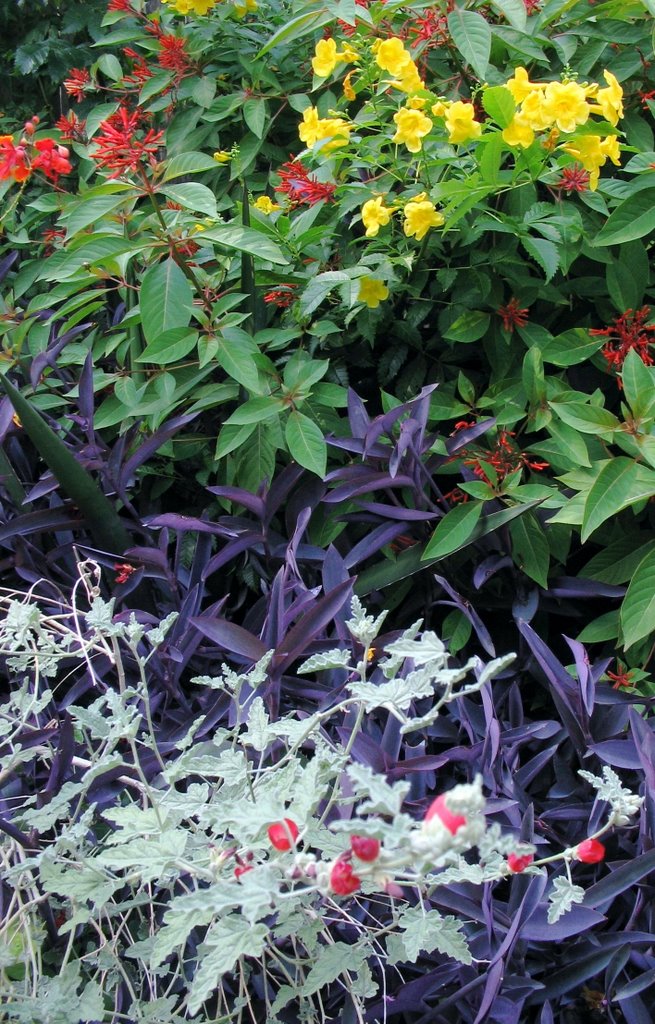
(The picture at the top is some of the toughest stuff in the garden, although it's in a newer bed, at the far back of the upstairs yard. From the top left: red hamelia/fire bush, tecoma stans/yellow bells, purple heart, and a silver-leafed, reddish salmon-flowered mallow I got at Big Red Sun a few years ago.)

Monday, August 28, 2006

Back to the garden

About six weeks ago we moved into the new space added in our backyard and I rediscovered my garden. Before we built the addition, the only real view of the garden was from the carport. I could catch a few glimpses from inside the house, depending on the time of year and how overgrown various plants were, from the kitchen window and from the dining room, looking through the screened porch. Now the new sitting room opens onto a covered porch and, from there, directly into the upstairs garden.

Since January the garden had been hidden by piles of construction debris and building materials. The hose bib in the upstairs backyard was demolished along with the old garage apartment and the long hose disappeared at the same time. I managed a few times to pull the short hose from the downstairs hose bib up and over the wall and watered the closest plants but mainly the garden was ignored. Despite the dry spring, it handled the lack of attention better than I had hoped. Fortunately, the builders were more careful than I expected. Even the plants along their path around the corner of the new building and into the yard were only slightly damaged. The Pride of Barbados and the yellow bells were shoved around a bit but are blooming as wildly as ever in these hot August days. Even more miraculously the mallow plant with the silvery leaves and pinkish salmon flowers that I bought at Big Red Sun a few years ago survived being stepped on, crushed again and again, covered in piles of plywood. A few branches broke off but it has recovered and is still blooming.

Once the water was turned on I started sprinkling, more than in past summers, both because I hadn't watered all spring so I felt justified in splurging on water and money and because the garden is such a bigger part of our life now. I've spent some time pulling weeds -- damn that Bermuda grass!! -- and pruning a few things. The only plant that had to be cut back completely was the Jerusalem sage, which suffered some kind of heat stroke and never recovered even with deep watering. A stub of it remains with a few forlorn leaves. I'll wait and see what happens when -- if? -- the temperatures drops one of these days. That spot is directly on axis with the big sliding door in the sitting room so I want something dramatic there and the J. sage just wasn't cutting it. Maybe I'll move it? To the new space at the left side of the far back bed?

Today I pruned the volunteer chile pequin out of the Old Blush rose which is blooming — tiny pitiful blooms — despite the heat. I fertilized all three roses — it and the Climbing Pinkie on the steel teepee and the one-year-old Maggie — last week with Lauren's favorite Rabbit Hill Rose Food. They all look okay. The Mexican bush sage and the St. John's Wort are crowding Maggie, though. I think the St. John's Wort is going to have to go or be moved this fall.