Tuesday, March 20, 2007

Out the kitchen window


Here's my attempt to show what the wisteria looks like out the kitchen window. From the window, what I see is the wisteria showering down from the right, with the Old Blush rose behind it, covered in pink flowers. I'm not sure you can see the roses in the picture and I couldn't really give a sense of how the wisteria dominates the view at this time of year. If I was a foot taller (or willing to lie across the sink and hang out the window) I might be able to get a better shot but, between my short stature and the blocking effect of our casement windows that don't crank all the way open, this is the best I can do.

Wisteria, just past peak


I believe that this year's wisteria bloom was at its peak yesterday. Today more leaves are showing and, although there are still buds that haven't opened, the breeze and light rain we've been having on and off all day have knocked petals off the existing bloom stalks.

Here are some pictures of what it looks today, both overall and close-ups of some of the blooms (I had to use our old camera so the pictures may be slightly low resolution).


If it rains in the next few days most of the blooms will be knocked to the ground. I'm always sorry to see them go — and the heighth of the bloom is so fleeting — but the carpet of lavender is lovely in its own right.


I wish I could get a picture out our kitchen window, with the wisteria in the foreground and the Old Blush rose bush, covered in pink flowers, behind. I'll try it and if it works I'll post it later.

Saturday, March 17, 2007

Forking foul-up

I was so excited to get out and start digging up the garden with my new garden fork that I didn't stop to think about where I was digging. I started in on the section of the far back bed where I'm planning to move the badly placed hypericum and immediately struck roots of the Ashe juniper that we cut down last year. I was pulling out giant sections of half-rotted root and turning over huge chunks of soil. I was accomplishing so much, so easily.

My husband had come out to admire my digging prowess when I hit something that felt really big. I assumed it was the mother of all roots and I pushed and pulled and levered and finally pulled up . . . the plastic drainage pipe from our new gutters!

Once I uncovered the whole section of the pipe (it's ridged black plastic about four inches in diameter) that I'd been attacking I found it riddled with holes. And at first we thought I'd cut it completely in half, since one end was poking up above ground and we couldn't even find the other end. We finally realized that I'd speared it just above a joint and had pulled one section out where it was shoved into the next section. We pondered the problem for a while and decided that if we could get the exposed end back into the continuing section and then covered up the various holes I'd made with the fork so that dirt wouldn't gradually fill in the pipe we'd be okay (we decided it didn't matter if the pipe leaked a little on its way to drain out into the alley; hopefully we haven't created the beginnings of a marsh back there). We made a trip to Home Depot to look for repair materials and finally decided that wrapping the wounded pipe with a plastic garbage sack and then backfilling with soil would solve everything for pennies.

I meant to take pictures to show the power of my new gardening tool but once I got started putting it back together I was too glad to get the embarrassing evidence covered up to remember the camera.

Thursday, March 15, 2007

Belated birthday

Today I received not one, but two, belated birthday presents — and both were for the garden. First, when my husband went out to bring the papers in this morning he found a box from the Antique Rose Emporium on the front porch. Apparently it was delivered yesterday afternoon but the UPS person just dropped it off without ringing the doorbell and none of us happened to notice it. Inside was a robust, one-gallon Cecile Brunner rose from my lovely mom and dad in Dallas. When I called my mom, she said the Rose Emporium people told her Cecile Brunner was a small shrub, perfect for a pot, which is just where I intend to put her (as soon as I can find the perfect pot). According to the Rose Emporium's website, Cecile Brunner has light pink blooms and is nicknamed the Sweetheart Rose. It tolerates poor soils and even partial shade. I'm thinking that, for now at least, I'll put her in a pot, maybe up on a plinth of some kind, in the far back, providing a focal point back there while the hamelia, yellow bells and Pride of Barbados resprout and fill in this spring.

Then this afternoon my friend Alisa came by to take me out for a birthday lunch (we've been trying to find a time when our schedules meshed since my actual birthday in late February and we finally made it work today) and she brought me a present that I can already tell is in the category of "how did I ever garden without this." It's a garden fork and I've been out digging up various parts of the garden with it all afternoon. I mean really, I've been digging in this garden for nearly 13 years and at my other house for seven or eight years before that and I've never had a garden fork. It's been on my wish list for a while (clever Alisa for listening to me ramble about my travails in the garden) and I even thought about a trip earlier in the week to look for one but was put off by the rain. I can already see that the fork will make digging up and moving plants much easier and I've got my eye on several to experiment with. In the picture my new tool is next to the hypericum that really needs to be moved.

After lunch Alisa and I headed out to do some garden shopping. We didn't make it past the Natural Gardener (we meant to go to Barton Springs Nursery too, to make a dent in a birthday gift certificate I received earlier — do you sense a birthday theme? — but we ran out of time) but we made our time count. Alisa, who rarely sees a plant she doesn't want, a woman after my own heart, bought a lush orange tecoma stans and a leatherleaf mahonia (she loves the berries) as well as a bamboo muhly (Pam, I told her you had recommended it to me and that sealed the deal for her) and various other things. With the Barton Springs gift certificate in my pocket, I restrained myself (I even put a few things back after they'd made their way into the wagon!). I bought three 4-inch bat face cupheas, three 4-inch winecups and one extremely cool euphorbia rigida, also known, the tag says, as gopher plant (that's it in the picture). How could that be anything but cool? They had one in the ground in one of the display gardens; like most euphorbias I'm familiar with, it doesn't exactly flower but gets these interesting chartreuse and yellow bract-like things on the tips of each branch in the spring. I'm thinking of putting it into the spot where the hypericum now is (the hypericum gets too tall and wide for the Maggie rose next to it but I think the euphorbia will stay low and kind of sprawl under the rose).

And when I get finished in the garden I can come in and slather on some avocado butter, olive and basil body butter, another gift from the lovely Alisa.

March blogger bloom day


I noticed on Zanthan Gardens' site that today is March Garden Bloggers Bloom Day (an idea of Carol at May Dreams Gardens, a blog I've not looked at before, for garden bloggers to list everything blooming in their gardens on the 15th of each month). I admire Zanthan's meticulous garden recordkeeping and, while I'm not sure I'll ever manage to collect the depth of information about my garden that she does about hers, I think I can manage to compile a monthly list.

So here's my list for March (using Carol's rule that buds count, at least in March):

• Bush germander (Teucrium fruticans); the variety with the darker flowers
• Salvia greggii (raspberry), first blooms opened this week
• Old Blush rose, covered in buds and blooms (shown in picture at top)
• Salvia nemarosa "May Night", several buds
• Pansies and violas in a pot
• Orange bulbine (Bulbine frutescens)
• Wisteria, about half the buds are open (see yesterday's post for a picture)
• Potato vine (Solanum jasminoides), the white variety

And a few more I thought of later, on places I forget to look earlier:

• Texas mountain laurel, hidden away on the side of the house
• Mexican honeysuckle, which bloomed hidden away all winter in the front bed
• Yellow bulbine, hidden under the yaupon in the front bed

Wednesday, March 14, 2007

Wisteria (and other) updates


I meant to take a picture of the wisteria blossoms each day so I could track the progression from bud to flower but the recent rain foiled that plan (not that I'm complaining about the rain!).

Here is a picture of some of the wisteria flowers as they look today and an overall shot of the whole vine in early stages of its bloom. The flowers are probably 1/3 to 1/2 open. It will probably be in full bloom by the weekend.


The rain has, in fact, been lovely. A deluge Sunday night, continuing all night, and then almost constant steady soaking rain on Tuesday. I wish we had a rain guage so I would know exactly how much we've gotten over the past few days. I estimate 2 to 3 inches.

As I poked around this afternoon I found the first sprouts from the stumps of the two hamelia plants and definite signs of life in the til-now lifeless clumps of Mexican flame vine. I even think I see the very first hints of new, red growth at the base of the Pride of Barbados in the far back. I had just about given it up for dead and was pondering its replacement.

The rain has bent the Old Blush rose almost to the ground, leading me to belive that I didn't prune it enough last week. I really don't know how much such a rose should be pruned. It's been in the ground about 4 years, I think, and has gotten quite large, about 5 feet tall and probably 7 or 8 feet wide. I pruned back some of the lower branches and some interior canes a week or so ago but, since it was already budded out I hate to chop it back too much (it was covered with buds before the last freeze and those buds were damaged, shriveled and not fully developed when they opened, but it's developed additional buds since then).

Oh and the first salvia greggi flowers have opened, on the plant to the left of the Old Blush. The other two haven't shown any signs of buds yet.

Thursday, March 08, 2007

Wisteria watch

As I mentioned a few days ago, the wisteria has suddenly budded out. Every year it takes me by surprise and this year was no exception. From bare sticks the buds just seem to appear overnight (either that or I'm just not as observant as I'd like to believe). According to my somewhat random record keeping it usually is in full bloom by the third week of March, with the blooms lasting a week or two depending on wind and rain.

Here's a few not so great shots of the buds as they look today (I'm still attempting to master the close-up setting of the camera).


Right now they look like pale, elongated raspberries. I'll post again in a few days as the buds mature.

Every year, before the wisteria starts budding out, I stand underneath it and consider some kind of pruning. I read an article in a magazine a few years ago that described a systematic approach to pruning wisteria that, it claimed, would result in a massive increase in flower production. But as I stand underneath the arbor, all I can see it a twisty, confusing mass of vines. Nothing like the illustrations in the article. I don't know where to start.

We've had the wisteria dramatically pruned once, but that was more to save our electric service than it was to do anything for the plant (the vine had reached up and twined itself around the wire bringing the electricity to the house; eventually a solid curtain of wisteria hung between the electric wire and the top of the arbor. When the wind blew, the curtain whipped back and forth, pulling the wire perilously close to breaking). We had that pruning done in March 2002, right before the wisteria would have started setting buds. I was afraid that the whole plant would die but when I mentioned that to the tree guy, he laughed. And he was right. The plant roared back, bigger than ever, although not with noticeably more flowers.

Maybe when (if??) we replace the arbor we can address the whole plant (which has trunks six inches in diameter) and bring it back under control. Or at least get the dead wood out and pull it back into some kind of boundary.

Wednesday, March 07, 2007

Clean-up, continued

I've spent several more hours hacking through various portions of the upstairs bed. I've got everything cleared and then some.

First, can I just mention my lack of enthusiasm for Turk's cap. I actually love the little swirled flowers but, in my garden at least, Turk's cap runs rampant. When I'm at the garden store and see Turk's cap for sale I find myself rolling my eyes. When I moved into this house I was mildly excited to find the various outcroppings of the plant. Now, 13 years later, I'm considering Round Up. I've cut it back, tried to dig it up. Nothing works. It spreads, it doubles in size every year. It dies to the ground and comes back at twice the size. The flowers look good for a while and then the leaves go all crinkly and half dead and it quits blooming and all I'm left with are straggly, six foot tall stalks that lean every which a way. Okay, I'll stop babbling.


Today I chopped — and chopped and choppped — down the eight or so major clumps of Turk's cap in the upstairs yard. And found even more spots where it's doing its best to spring up. And then just for good measure I chopped down most of the misbegotten yucca from the corner of the long bed. I left a couple of pups in the far back but I opened up some serious space for something new. In the picture you can see the two trunks of yucca that I sawed off (as well as piles of various other debris waiting to be bundled up).

The space is backed by the wisteria (which is on the arbor in the downstairs yard but which tries its best to creep into the upstairs bed) so whatever I put in there needs to be able to fight that off or cohabitate politely. I have a Pride of Barbados volunteer seedling in the front yard that I may try to move. And then there's the question of the monster hamelia just to the right of the new bare spot (well, in three months it will be a monster; right now it's a few bare sticks poking up out of the ground).

On a happier — or at least less agressive note:


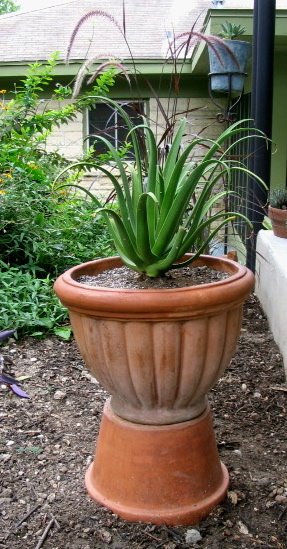
Here's the manfreda "Macho Mocha" that I bought late last summer. It's grown enormously and has now taken on its characteristic spotted coloration. And it's got at least three pups growing under the bottom fronds. The pot stayed out during the cold weather; we might have been able to move it but I decided to take the chance. I covered it during the ice storm and on a couple of other cold nights but the cold didn't seem to bother it at all. I'll give it a bit longer and then I'll try to remove the pups and repot them.

Monday, March 05, 2007

Treasure hunt

Gradually I've been whipping the upstairs garden into some sort of shape. I've gotten all of the perennials that died or nearly died to the ground cut back (although a mountain of debris now clutters the yard, waiting to be tied into bundles by my able assistant).

Today I cut back the Pride of Barbados in the far back, along with the tecoma stans and the red hamelia, all big woody plants, some stalks probably nine or ten feet tall. When I started on the tecoma stans I was worried that it was completely dead but a bit more hacking revealed the smallest sprigs of bright green down at ground level. The same job revealed the vine — why can I not remember what kind it is; not crossvine, not coral honeysuckle; oh well, it'll come to me — that I planted several years ago, hoping it would cover the back fence and climb up the utility pole. It's never done that but last summer it did have a few flowers — trumpet vine, that's it, Madame Galena, I belive is the variety — and although it mostly looks dead as a doornail I spied one sprig of new growth today.

The Pride of Barbados shows no signs of new growth. I'm a bit worried about it but the hamelia I'm sure will be back, despite its current pathetic look.

Also revealed in the far back are numerous pups of the agave that last fall I identified as agave lopantha. It's the plant that outgrew its spot in a big pot in the front yard a few years ago. I've already got several of its pups in other places. I think I'm going to have to find homes — homes beyond my yard — for these new ones.

I also found sprouts on a yellow brugmansia I have in a pot in the downstairs yard but the salvia guaranitica "Black and Blue" in a big pot that was already resprouting before the last freeze isn't looking so good.

I'm feeling better about the garden than I was a week or so ago although there's still much to be done. I'm pondering removing the yucca that has long anchored the corner of the long L-shaped bed in the upstairs yard. It's the sole plant remaining from the barren wasteland that was the yard when we bought this house nearly 13 years ago. But I think it has to go. I may have said before that we actually tried to get rid of it a few years ago when it started looking particularly raggedy but it sprang back from a stump. If it was gone, I'd probably also get rid of the orange hamelia beside it. I much prefer the red version, both for the color of the flowers (or are those bracts?) and for the reddish hue of the foliage. That would leave a huge gap, ripe for something new.

Oh and the wisteria (on the miserable arbor) has shot out buds virtually overnight (just like all the elm trees in the neighborhood; one day to the next and suddenly tiny leaves cover every branch). I'll take pictures when it blooms in a week or so. Ugly arbor or not, it's usually quite a sight.

Tuesday, February 20, 2007

Spring cleaning (or kvetching)

I'm in my usual pre-spring garden funk or at least state of garden indecision. I realized a few years ago that, about this time, before plants resprout, when bare stems are the only thing showing above ground, I start to wonder if the garden is worth the trouble. I look around and all I can see are the problems and none — or at least not many — of the rewards.

Last weekend I finally got out and started cutting back the plants that froze to the ground during the several unusually cold spells we've had this winter (the lowest we've seen here was about 22, I think): the salvia "Anthony Parker" in the downstairs bed, the big salvia guaranitica "Black and Blue" in a pot, several clumps of salvia leucantha, the zexmenia at the top of the stairs. Also the two big clumps of Mexican flame vine that hang down over the wall. Those vines have survived for years, in fact one of the two clumps sprang up where a long tendril of the original plant reached across the bed and rooted. I've been amazed by their hardiness over the years (I planted the original assuming it would die the first winter). This year may be the end though. I see no evidence of green, even right down at the ground. I'll wait a bit longer before I pull them up but I'm not optimistic. Still to be cut back are the tecoma stans, the hamelia and the Pride of Barbados in the far back. Also throughout the long upstairs bed are masses of purple heart in their slumped and slimy post-freeze state. And various salvia greggiis needing severe haircuts before they start setting blooms.

With some of the dead wood out of the way I can see things I'd like to change: remove the big yucca at the corner of the L-shaped bed and the orange hamelia beside it. Replace both with a new red hamelia set further back into the corner. I think the hamelia could hold its own with the wisteria that tries to creep in every year. Then, once the original hamelia is gone, I could move the salvia leucantha over to give the Maggie rose more space.

We had some of the scrubby trees along the north edge (and on the other side of the fence) of the upstairs yard removed when the tree people were here dealing with the branches downed by the ice storm. They took out a hackberry that was growing up into the wisteria and an insidious mulberry that will resprout in a minute — okay a few months — if I give it any slack. I'm thinking Round-up on the stump. Or boiling oil. Also removed was some kind of overgrown nandina-ish thing that was only served as mooring for errant lashings of wisteria creeping along the ground, looking for a way upward. The tree guys also cleared the wisteria off the power pole and, most satisfyingly, removed the four Trees of Heaven growing up between our house and the duplex next door. The trees were on the duplex's property and the owner had refused for years to remove them, even though they were clearly a menace to her property. We finally said we'll pay for it ourselves and then she said, oh, I'll be glad to pay half.

So the upstairs yard is looking a bit clearer but the downstairs yard is disaster. All of the grass, except for various odd straggles of Bermuda, is dead, the arbor is rotten and collapsing and the whole area has become a repository of cracked pots, old ice chests, and various other detritus. Depressing doesn't begin to describe it. In my brighter moments I envision a sort of terrace of large stones set in gravel, surrounded by plants rather than bare dirt, shaded by a new wisteria-covered arbor, with perhaps a fountain at the center. Then I look at what's actually there and start hacking at the mutant eupatorium of unknown variety that has sprawled randomly and unattractively out of its assigned spot. Or stoop to ponder the once lovely agave montana, now apparently dying a slow and undignified death. Can it be saved? should it be moved? taken out of its pot? put where?

Then there are the roses. To prune or not? And when? And how much? But that's another post.

Thursday, January 18, 2007

Dodging the shards

Life returned to something like normal this morning after two days of suspended animation. School was delayed by two hours, which meant we didn't have to get up until an oh-so-civilized 8 a.m. instead of our usual 6. I could get used to that.

By 9, huge chunks of ice were cascading from the magnolia tree. I kept stepping outside to make sure that the crashing sounds were only ice and not more limbs falling. As far as we can tell only a few small branches, in addition to the one big one that snapped off yesterday, are actually broken. The bigger limbs are still hanging low in spots but that seems to be more about the water still on the leaves than any damage. The tree looks much like it usually does after a heavy rain (except for the shards of ice piled underneath. A truly amazing amount of ice. Each leaf was coated and each piece fell, sometimes one or two at a time and other times one piece from the top starting an avalanche).

The orchid tree and the roses seem to have rebounded although Old Blush got pushed down and in on itself and is now tangled and leaning. I think once it dries out a bit and I can get in there and untangle the canes, it will be mostly back to its old self. It probably needed to be pruned anyway.

A number of things that hadn't frozen back will need to be cleaned up: the Mexican flame vine, the purple heart, zexmenia, purple fountain grass, and the Pride of Barbados and hamelia. It's supposed to rain for the entire next week so it may be a while before I get out there with my loppers.

I was sure this freeze would be the end of the big agave americana near the front door. Last year, in temperatures in the mid 20s, even covered it suffered considerable damage. We thought about replacing it but by mid-summer last year we hadn't gotten around to it and it had put out enough new fronds to look presentable again. On Sunday or Monday when I was bringing plants inside and covering things I didn't do anything about the agave. And, as far as I can tell, it's mostly okay. Maybe the thick coating of ice protected it? Or maybe the temperatures just never got low enough to damage it?

Wednesday, January 17, 2007

On ice

We're near the end of our second day housebound because of the ice storm of 2007 (that should be in all caps with theme music, I think). Yesterday, we made it out of the house for some grocery shopping and a trip to get the expansion pack of World of Warcraft — but Mom, it comes out today and we do have the day off from school. The street doesn't really look icy, does it? — before the snow and sleet started to fall again mid-morning.

The garden — and everything else — is coated with ice at least a half inch thick. It's beautiful and strange.

We lost one large limb of the big magnolia in the front yard this morning. We were sitting in the living room chatting when this huge boom sounded from somewhere outdoors. I don't know why I hadn't thought about any of our trees losing limbs but somehow it hadn't occurred to me. We went out just to take a look around and there was a limb, probably eight inches in diameter, lying propped against our neighbor's house. Fortunately, it not only didn't damage their house but also seemed to have spared the mountain laurel that it grazed on the way down. So far that's the only limb that's obviously broken, at least on our property. A tree in our neighbor-on-the-other-side's yard split and half landed on our roof, again apparently doing no real damage although we'll have to get up on the roof to see if any shingles were scraped off. We called a tree guy this afternoon and, surprisingly, he said he could come out tomorrow and get it taken down and maybe do something about the ragged break in the magnolia as well.

The orchid tree in the backyard is bent nearly to the ground as is the Old Blush and Maggie roses. I'm worried about breakage in both of them although I think they'll survive the cold just fine. The coldest it's actually gotten here is about 28 but mostly it's stayed around 30 so I don't think much of anything will be lost because of cold (okay, I'm hoping since this is the most protracted cold spell we've had in a long, long while; who knows about some of the newer plants).

I tried to shake some of the ice off the orchid tree but the cracking sounds scared me. I couldn't tell if it was ice cracking or the tree itself so I gave it up and came back indoors. The orchid tree still had almost all its leaves (as, of course, did the magnolia and the roses) so they're in the worst shape with ice all over not only the branches but the leaves as well.

Thursday, December 14, 2006

Not gone forever

I haven't posted since Halloween. Every day I walk out into the garden and think, I'll go in there and write something. Just a few words. And then I get back into my office and get sucked into something else and don't do it. I think one reason I haven't been posting is that I feel like I must have a picture (I look at Pam's postings, with their beautiful images and feel even more intimidated). But getting the camera out is just one more thing and sometimes its one thing too many.

So, no picture today. Just words.

After the freezes of the past few weeks, the garden is in a crispy, limp place, at least most of it. The two hamelias were the first to feel the cold, the outer layers of foliage going a reddish brown and then, with even colder weather, actually crisping up and falling. Same with the yellow bells, the purple heart, the Mexican flame vine, and the Pride of Barbados. All semi-frozen but not down to the ground. I need to get in and whack things back but I'm always wary at this point of more of this 75, 80 degree weather that just encourages everything to send up new growth. Maybe I'll wait a bit.

All three roses made it through the freezes with no damage. All three were covered in buds before the first freeze and I was sure I would lose all those flowers but so far they're blooming away. Maggie is much happier with the various things — hypericum, flame vine, salvia leucantha — trimmed away. The flowers are as fabulous, both in looks and scent, as I remembered. Old Blush has been covered in blooms. I was out this morning examining it, trying to decide whether to prune back the stalks where the petals have fallen. Again the question of encouraging new growth. Hmmm . . .

Speaking of the hypericum, it's coming back with a vengence. I chopped it all the way to the ground and it's sending up new growth from every bare stalk. One tough plant. I think I'll dig it up and move it. If it's that tough even my manhandling style of transplanting probably won't kill it.

I brought all the succulents in, either to the screened porch or to my office, before the first freeze. Now I can't decide whether to move them back or leave them inside. Some of them are unwieldy but others look a little sad indoors. Sure as anything, the day I move them out another cold front will swoop down. The perils of Austin gardening.

I did leave the manfreda Macho Mocha outside in its pot, which was just too big to move. I covered it with a sheet and it's doing just fine. We covered the big agave Americana in the front with a couple of sheets too. Last winter it sustained serious damage, even covered. My theory was that it's reaching the end of its life (the mother plant, anyway) and was therefore more fragile. But so far this year it's fine. Maybe it was just colder last year.

Tuesday, October 31, 2006

Finally, some progress (I hope)

Last Sunday I finally decided to take some action in the garden. I puttered around for a bit, trimming here, pulling a weed here, before I got up the nerve to chop down the overstayed-its-welcome hypericum/St. John's Wort that was blocking my view (and air and sun) of the "Maggie" rose that I planted a year and a half ago or so.

I planted the hypericum in March 2003 at the base of an orange Tecoma stans (we always called it the orange bells). I was looking for something that would look good in the spring when the orange bells was just sticks waiting to sprout (the lightest freeze killed it down to the ground). Whatever I planted needed to be able to survive being smothered by the orange bells when it reached its full height and spread (about 10 feet by 8 feet) later in the summer. Someone at Barton Springs Nursery suggested the hypericum, supposedly a dwarf variety, or daylilies. I've never been a daylily kind of person so I went for the shrub.

For the first few years it didn't do much but by 2005 it had grown larger than I expected, maybe four feet tall and wide and had bloomed a bit. I loved the buds, tiny balls that opened into clear yellow flowers. Unfortunately there weren't many flowers and the plant suffered in July and August. It didn't die but it didn't look great either. That wasn't so bad when it was covered with the sprawling orange bells but . . .

In April 2005 I decided the orange bells had to go. Unlike its yellow sibling (or parent?) it didn't bloom profusely, most years not flowering until late July or August, sometimes even later. And, although the individual flowers were beautiful there just weren't enough of them. And the plant itself was so ungainly and huge. It blocked my view of the upstairs garden from the kitchen window and smothered everything around it.

After a trip to the Rose Emporium with a friend where we sniffed every rose that was blooming, I had my eye on a rose called "Maggie" that was beautiful and smelled wonderful. I came home and told my husband I'd decided to take the orange bells out and put in the rose and some other stuff.

Hah! We (mostly he) spent a week of evenings digging and hacking roots (some 4 or 5 inches across) and shoving the root ball back and forth trying to loosen it up. We talked about hiring someone with a stronger back and better tools but in the end we got it out of there. I dug in a bunch of compost and then went crazy planting what looked like an enormous space.

I checked my garden notebook on Sunday and saw that I planted the rose, a Mexican bush sage (one with solid purple blooms) that I'd had in a pot for a year or so while I tried to find a spot for it, a magenta salvia greggii, some purple and fuschia verbenas and some 4-inch cleome transplants. All in an area about 10 feet by 4 feet that was already home to the hypericum and a small agave as well as a zexmenia. And bordered by a hamelia patens (fire bush) that in April was also nothing but sticks and two clumps of freeze-pruned Mexican flame vine that always go out of control by mid-summer.

Even at the time I wondered if I was putting too much into the space and noted that I always underestimate the summer size of the hamelia. But, I wrote, the cleomes were annuals and the verbena would be easy to move. It's bound to be better than the orange bells, I wrote.

And that first year it was. The hamelia indeed got bigger than I remembered and it and the Mexican bush sage mingled together but that worked okay. The salvia bloomed and even the hypericum had a few more flowers than I remembered from the year before. The few blooms I got out of Maggie that first year were as beautiful as I hoped. The cleomes and verbena filled in the blank spaces while the other plants were growing. It was all a bit out of control but I generally like that kind of look.

But the changes we made to the house and the surrounding hardscape this spring changed my perspective, literally. That area of the garden is now viewed not only from my kitchen but also from the new sitting room. And the hypericum was at the most prominent point, right at the top of the reconfigured stairs coming up from the screened porch and the downstairs yard.

By August the bush sage had overwhelmed the rose, abetted by the rampant, twining growth of the flame vine. The hypericum and zexmenia (and the vine) had spurred each other on to ever greater heights, all intertwined and, in the case of the hypericum, browned by the summer heat. I kept pruning things back to try to give the rose some room but, in the end, something had to go.


Here's a (bad) picture of what it looked like before. You can see what a mess the whole area was and how it relates to the new porch.

So on Sunday I chopped the hypericum down. I still need to dig up the stump (I suspect it's one of those plants that will shoot back up, even from leafless, bare sticks) and, even though it looks a bit barren right now, I think in the long run it will be an improvement. I just have to resist the urge to fill up the space with whatever plants I have languishing in pots or some bargain I can't resist at the garden store.

My question now is whether to try to dig up the rose and move it over a foot or so, giving it some more breathing room from the bush sage. I've never tried to transplant a rose. I'm thinking maybe Maggie will sort of grow sideways to fill up the new vacant space, kind of like the bush sage does to stay out of the way of the hamelia.

I'm also thinking about digging up the agave (it suffered from years of being covered all summer by the orange bells; twice the crown of new stalks either rotted off or were eaten by something). I'll replace the agave with another slightly larger, more attractive agave I have in a pot. The magenta salvia has grown out over the edge of wall, pushed out of shape by the hypericum, but stilll blooming. I'll leave it and the flame vine even though the vine sends out tendrils that ensnare everything. But those orange flowers are hard to beat, especially spilling down over the wall.

Wednesday, October 04, 2006

Still pondering

I haven't been doing any gardening, beyond watering and trying to contain some plants that have gone out of control. The salvia leucantha, blooming beautifully, has overrun the Maggie rose, which is threatened from its other side by the disappointing hypericum (St. John's Wort, supposedly a dwarf variety that's at least four feet tall and has never done much but sprawl and turn brown in the summer if it isn't watered; I've only gotten a few measly flowers every spring — but such cool flowers; I love the way the buds start as little balls before they open). Cool flowers or not, I think it's history as soon as the zexmenia that has grown up through it stops blooming and I can chop the hypericum down without losing a bunch of flowers. Then I may need to move the rose, although if I move it much it won't get enough sun (and I've never tried to move a rose; possible or no?). Then there's the Mexican flame vine in the same area that has responded to water and cooler weather with rampant growth (and even some blooms on the section that gets more sun).


I love the flame vine's buds, opening like little claws, and I like the way the vine looks trailing down the wall but — kudzu-like — it overtakes anything in its path.


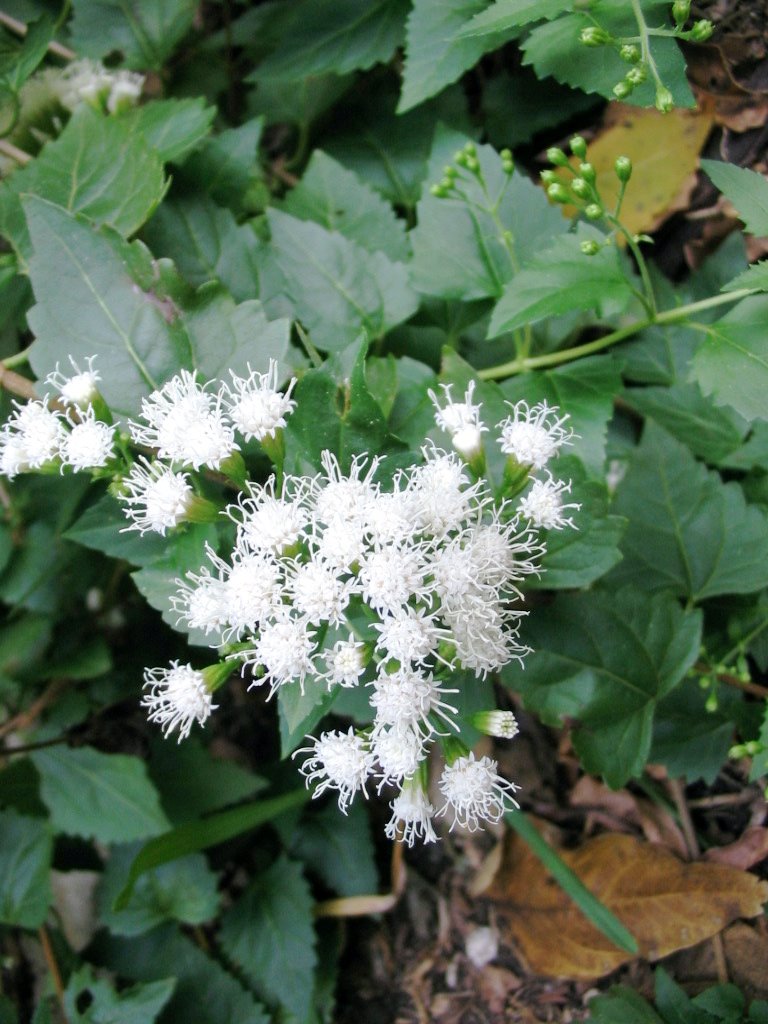
Then there's the whole downstairs yard, something of a disaster area at present. The arbor needs to be replaced (without destroying the overgrown wisteria) and something needs to be done to give the whole area some sense of purpose. It's such a mishmash of dead grass and empty pots and mud. Oy. I say. One bright spot is the eupatorium havenese (I think that's what it is; definitely some kind of mistflower but tall with white blooms) is covered in buds; some start opening this week.

It's a cool plant when it's blooming but it's really not well situated. It's so sprawly that I think it needs more space to look it's best. Something else to think about moving.


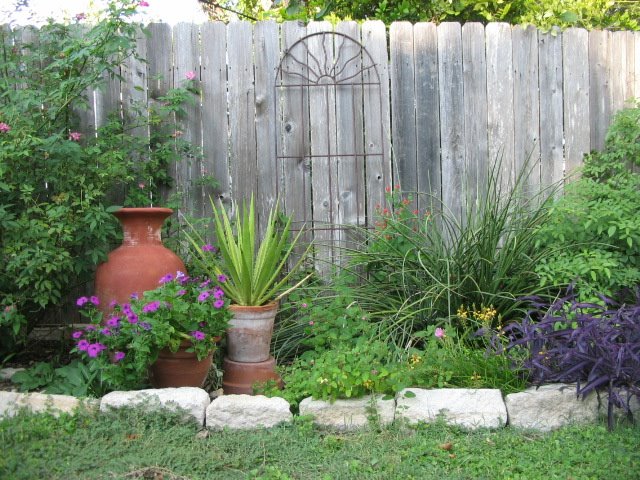
Another plant I need to deal with is the red yucca between the Old Blush rose and the Climbing Pinkie on the steel teepee.(You can see it in the picture behind and to the right of the pots, up against the fence.) It hasn't bloomed in a couple of years (not enough sun?) and I'm tired of it. I need to figure out what to put in there: something tallish but not too sprawling, something that looks good even when it's not blooming, maybe something with some interesting foliage rather than blooms? I put the yucca in there originally to give the whole area some structure instead of just sprawling randomness. Maybe something else along those lines.

Monday, September 25, 2006

Hummingbirds


I don't know if this is an exceptional year for hummingbirds or if I'm just spending more time in the garden this year but I don't think I've spent more than five minutes in the upstairs garden over the past three or four weeks and not seen at least one hummingbird. I think the most I've seen in the yard at one time is four.

They perch on the telephone wire that still runs above the upstairs garden (darn that SBC who wants $500 to move the line to the other side of the house) and the spiraling branches of wisteria shooting out from the telephone pole, their delicate chirps calling me out onto the porch. Then they're off, sipping from the yellow bells, the hamelia (that's what's blooming in the picture, minus the birds themselves, which I've been unable to catch in a picture) and the Turk's cap, but also trying out the various salvias and even the small blooms of the Old Blush rose.

I have no idea if they're all the same species but they do seem to be variously colored. This morning I caught a glimpse of irridescent green swooping across the yard but most have been less colorful grays and browns, at least in the brief peeks I've gotten as they flit here and there.

Any idea how long they're here? I assume they must be migrating and are fueling up for a long flight somewhere to the south.

Thursday, September 21, 2006

Enjoying the breeze

I've been sitting out on the porch, watching the limber branches of the pecan trees to the north of us swirl in the shifting breeze. I got up the energy to water the three roses deeply (okay, I just stuck the end of the hose at the base of each one for twenty minutes or so while I contemplated) but I still haven't figured out what to do with the purple fountain grass or the plumbago that I bought a couple of weeks ago. I did get the manfreda "Macho Mocha" into a pot last week and I'm quite excited that it seems to be developing its characteristics purple spots. I'll post a pic (once it actually does something you can see in a picture and once I get the camera back in action; I was just making some progress figuring out some of its more advanced features and I ran out of battery power).

The salvia "Anthony Parker" is starting to bloom and the salvia guarantica "Black and Blue" in the pot that I chopped back severely a few weeks ago is springing back to life, although there are no signs of any buds yet. The salvia nemarosa under the Old Blush rose has perked back up (it kind of hibernates during the summer) and one of the plants has sent up a bloom stalk. The yellow bells is still blooming wildly and so are the raspberry salvia greggiis the pavonia and the Mexican bush sage, both hamelias, the globe mallow and the zexmenia. The berries on the volunteer chile pequin are turning red.

The Old Blush is also blooming but the blooms are little wimpy things. I have no idea whether its stunted by the heat of last month or whether there's something else I need to do to it. When the camera gets fixed I'll post some pictures and maybe someone will have some ideas. Feed it more often? Water more regularly? The plant itself looks good and its sending up a lot of new growth in this cooler weather but the blooms are still so small.

Now that the upstairs yard is so much the center of my attention everything else has been languishing. I need to think about the downstairs yard and the front bed. And we've been talking about getting rid of a lot of the grass in the front yard (mostly dead anyway) and converting it to some kind of other planting. I'm still afraid of the return of hot weather so maybe I'll give it a few more weeks before I try digging things up and moving them. I'll just sit and contemplate for a bit longer.

Monday, September 11, 2006

Impulse control


Now that I'm working in the garden again I couldn't resist a visit (or two) to the garden store this weekend. First I stopped in at the Great Outdoors (conveniently located within 5 minutes of our house). I have sort of hit-or-miss luck with the place but on Saturday I bought an agave I'd been wanting for a while, an agave bracteosa or squid agave. Its leaves are fleshy and pale green, with no spines on the edges or tips. And supposedly, unlike most agaves, it doesn't die after it blooms. I planted it in one of my favorite pots, empty since I left an aloe "Blue Elf" out in one of last winter's freezes (and it was just about to bloom; I was completely bummed).


I also bought a one-gallon Laura Bush petunia, just to put in a pot for some more color (I'm a sucker for that fuschia color on any plant; check out the salvia greggii in the background).

Then on Sunday D and I ran out to Barton Springs Nursery to pick up some cotton burr compost for the extension of the far back bed and to use as mulch and, even with him there as a moderating force, I couldn't resist a manfreda called "Macho Mocha" that I'd read about on the Yucca Do website (Barton Springs has a huge one in a pot up on a pedestal just at the east edge of the main barn, if you want to check it out). The one I bought is small and the leaves are all green but supposedly in sun it will develop a purplish color with brown spots. And then in the spring it's supposed to send up a huge, tall bloom stalk. I've had a manfreda (I think it's manfreda maculosa) of a more sedate nature in a pot for several years trying to find a spot for it in the ground. It actually does fine in a pot so I think I'll put the new one in a big pot as well for now.


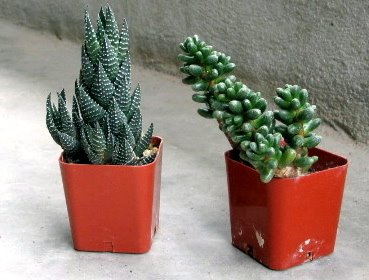
At Barton Springs I also bought a couple of odd little succulents; one I'm sure is an aloe of some kind but with a strange pyramidal growth habit I've never seen before; the other one looks a bit like the echevarria "Jelly Beans" I got last week, but in miniature form. I also bought, mostly because D admired it, a dark blue plumbago. The flowers aren't really all that dark blue but they are darker than a plumbago I had years ago. I'm not sure where it will go. It's not really a color I have anywhere in the garden but I'm sure it will work in somewhere.

I also bought another purple fountain grass, a gallon this time. I think I'll dig up the two small fountain grasses I bought a week or so ago and put them into a pot to stick somewhere else sunnier than the spot I've got them in now. Then I'll put the bigger new one (which is already blooming) in the place of one of them at the top of the new stairs, next to the stand with the succulent in a pot. It will be next to the eggplant-painted steel columns on the new porch and should blend together with the zexmenia that's blooming there. I think that spot gets enough sun to keep the grass happy.

I did resist the lure of a bougainvillea and another one of the salmon-flowered globe mallow plants that I already have in the far back bed, as well as a couple of other plants that were calling my name (has anyone tried a plant called melochia tomentosa? I saw it at both Great Outdoors and Barton Springs; supposedly it's a native but I don't remember seeing it before. It's also called pyramid plant and Yucca Do has something similar listed as melochia pyramidata or anglepod.) And then there were all those beautiful roses. Oh well, there's always next time.

Thursday, September 07, 2006

Survival of the fittest


In her post on Digging, Pam wondered how my garden survived not only the record heat of August but also the neglect imposed by our recent construction project (not to mention the insult of the construction itself). My first thought was good karma, some kindness from the gardening gods. But the real answer I think is more related to survival of the fittest (with a little luck thrown in for good measure; we had a wonderful architect and contractor — a design/build firm — and subs who were more careful with the garden than I ever could have imagined).

Some background (skip ahead to the end if you'd rather avoid the long-winded details):

The heart of the garden is a long L-shaped bed in the upstairs part of our back yard (our lot is on two levels with a four-foot-tall stone retaining wall separating the two levels. The original house is on the lower level and the new addition is on the upper level). When we moved in 12 years ago the only thing living in the upstairs yard was a large yucca and a straggly rose bush. We had several dead trees removed and I pondered the emptiness for six months. The next spring I hired someone to dig the L-shaped bed; the long leg — about 30 feet — is on the south side of a stockade fence, while the short leg — about 12 feet — runs along the top of the stone wall. Both parts face south and west, with almost no shade. The new beds were amended with quite a lot of compost and in at least some parts (behind the retaining wall) the soil is quite deep. Elsewhere it's maybe 8-12 inches over limestone.

I had done some gardening on a small scale at our previous house (someone gave me Wasowski and Ryan's Gardening with Native Texas Plants for a wedding present 20 years ago) and I knew I wanted native or at least drought-tolerant plants. So the original planting had clumps of red yucca (Hesperaloe parviflora), lantana "Irene," purple coneflower, coreopsis, salvia leucantha, fall obedient plant and calylophus. The ends were anchored by large clumps of salvia "Indigo Spires" and pink salvia greggii.

All that remains after 12 years is one clump of the red yucca (oh and that original yucca; we tried to dig it up once but it refused to give up the ghost and made a comeback from roots the next spring; it lives on). Some things reached the end of their natural life, some I sent to an early grave either through miscalculations regarding care or because I got tired of them for one reason or another.

I tremble to think of the plants that have poured through that bed (not to mention other smaller beds I've added since) in the last 12 years. In looking back through my sporadically kept garden notebook I can see one trend: If I had to water a plant to keep it alive it was history. I've moved more and more in that direction over the years. I'm willing to water plants in pots but (at least until recently) the upstairs garden only got water irregularly, maybe once or twice a month. (I usually add Back to Nature cotton burr compost from Barton Springs Nursery as mulch in the spring but I didn't get to do that this year.)

I've lost (or given up on) a lot of plants but those that remain are tough. I don't think there's a single plant in the upper back yard that really needs to be watered to live (to thrive and bloom is another story). The beds up there haven't changed since last year (my usual spring plant-buying frenzy was thwarted this year) and last summer — admittedly nothing to match this summer — everything survived.

This summer our experience of the upstairs garden changed dramatically. We moved into a new addition to our house in July that opens directly onto that garden. Both our new sitting room and bedroom, as well as our offices (my husband and I work from home), have views to the garden. So I have a newly vested interest in keeping that part looking good. Starting in mid-July I watered each section deeply once a week or so with my favorite small sprinkler (I've always meant to put soaker hoses in but every spring I wait too long and it gets so overgrown I can't push the hose through).

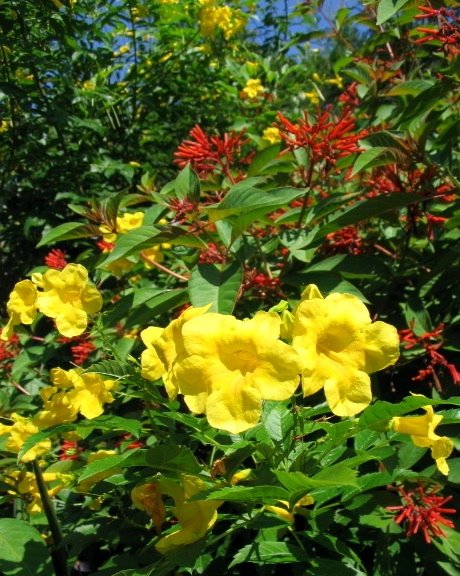
The yellow bells, Pride of Barbados, Turk's cap, hamelia, and zexmenia probably wouldn't be covered in blooms if I hadn't watered but I'm fairly sure they would have survived. I know the salvia greggii wouldn't be blooming again yet without the extra water but the salvia leucantha would have survived and bloomed anyway, I think, water or no water. The roses are the one thing I'm not sure of (I'm new to roses but I have three: Old Blush, Climbing Pinkie, and Maggie. One interesting thing is that all three did better than ever this spring and early summer with no supplemental watering, no fertilizer, nothing. Is there a lesson there?)

Other parts of the garden don't look so good right now (I haven't put up any pictures of those parts!). Some of the problems are a result of the construction and some a result of neglect. But not much, if anything, has died outright. I think the key was that everything that might have died has been gradually culled out (if I'd had a chance to add things this spring no doubt some of them would have died). As I said: survival of the fittest.

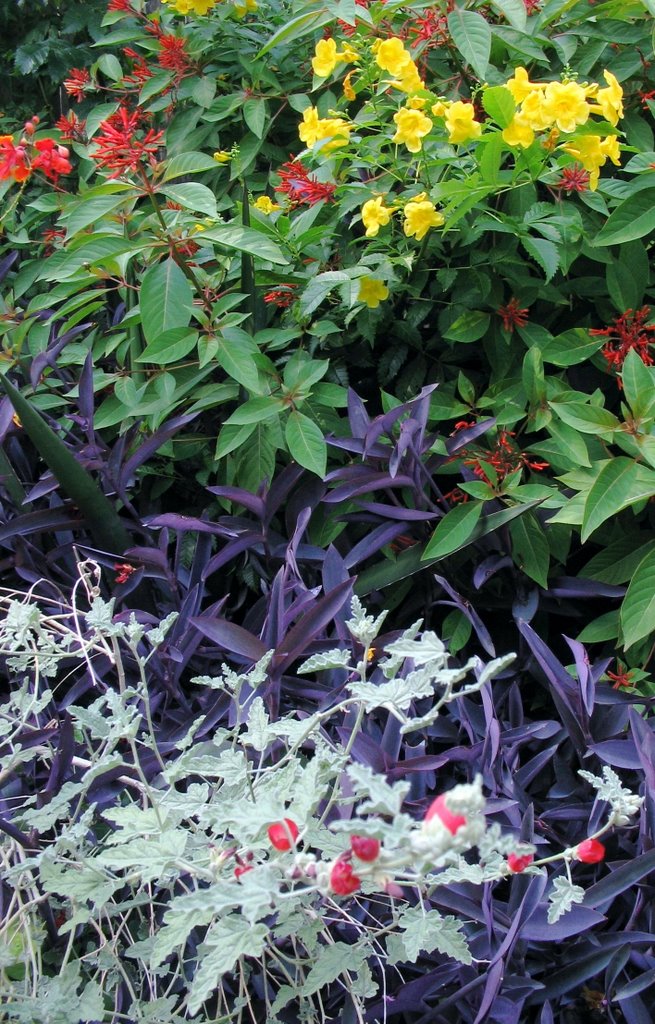
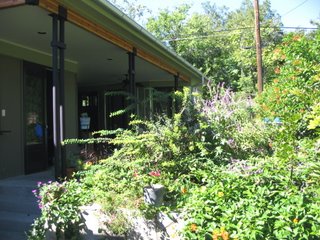
(The picture at the top is some of the toughest stuff in the garden, although it's in a newer bed, at the far back of the upstairs yard. From the top left: red hamelia/fire bush, tecoma stans/yellow bells, purple heart, and a silver-leafed, reddish salmon-flowered mallow I got at Big Red Sun a few years ago.)

Out of hiding

I was astonished this morning to find comments on several of the (few) entries in the blog. Entries from people whose blogs I've been reading for several months. And then I went to one of those sites, Digging, and found an entry about my site. Pretty cool. And thanks so much, Pam, for the kind words.

When I started writing here I mostly thought of it as something for myself, a way to keep better track of where I am and where I'm going with the garden. Since I was banished from most of the garden from January until July while the construction was going on, the moment when I got back to it seemed a good time to start something else new. And since I sit in front of a computer most of the day (in my fabulous new office that looks right out into the garden; am I lucky or what?), a blog seemed like the thing to try.

Anyway, even though I never considered that others might be interested in it, it's exciting that someone is.

A couple of years ago my fabulous next-door neighbor moved. She was my garden confidante. We shared plants and tales of woe and eventually the gardens between our two houses merged, her poppies and larkspur seeding themselves into my bed and my Copper Canyon daisy finding a happier spot on her sunnier side. My new neighbor is also a gardener but we have different tastes (she's a bit tidier, more orderly than I) and, sadly, I've all but abandoned the bit of my garden that adjoins hers as well as the sense of garden companionship. So having some kind of gardening community again is welcome. Thanks for the welcome.

(Oh, and I have changed the Blogger settings so that I think anyone can post comments now. Let me know if it doesn't work.)